

Related posts




View all
Article
-
July 6, 2026
Back to all
Execution capacity is proving harder to scale.
Across the energy sector, capital is moving toward companies built around electrification, grid modernization, decarbonization, storage, and new infrastructure models. While this creates an opportunity for founders, it raises the standard for performance. A startup that once had to prove its technology now has to prove it can commercialize, finance, build, operate, and report against investor expectations in an increasingly complex market.
That transition exposes a gap many startups do not fully anticipate. Technical knowledge may get a company to market, but it does not automatically produce the operating discipline required to manage project timelines, vendor dependencies, financial controls, regulatory obligations, and investor & consumer commitments. The task of managing operations becomes less theoretical and more institutional. Growth begins to depend on whether the company can turn capital into coordinated execution.
The consequences of the execution gap are measurable.
.png)
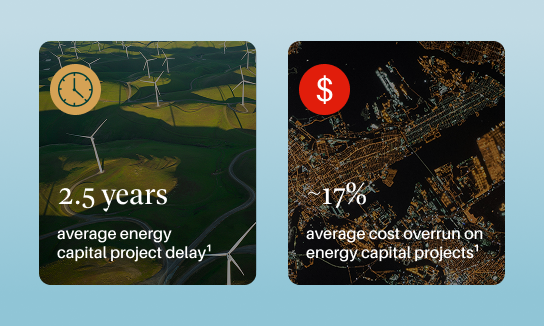
Bain & Company’s analysis of upstream and midstream oil and gas projects found that, from 2015 to 2019, projects were delayed by an average of 2.5 years and exceeded budgets by an average of 17%. At this rate, capital-intensive growth losses due to the execution will grow tenfold by 2030.
Why?
Projects that miss execution goals erode investor returns and elevate operational risk, even when capital is available.
The expertise gap rarely announces itself as a single failure. It appears in the ordinary mechanics of scaling: a procurement decision made too late, a permitting process underestimated, a project plan built without enough operational realism. Small gaps in judgment accumulate. Eventually, they become missed milestones, rising costs, and strained investor confidence.
Labor constraints make the problem more difficult to solve. The International Energy Agency reported that global energy employment reached 76 million workers in 2024, up more than 5 million jobs since 2019. Yet growth in employment has not removed the shortage of specialized skills. According to Energy Digital’s coverage of the IEA report, roughly 60% of surveyed energy companies reported labor shortages.
This creates a difficult operating environment for growth-stage startups to get ahead, which need deeper expertise at precisely the moment that expertise becomes harder to secure. Founders are often asked to manage a wider range of decisions than their organizations were originally built to support: how to sequence capital, when to hire technical leadership, how to structure vendor accountability, what investors need to see before the next raise, and where operational risk is quietly building.
Traditional advisory models can help with parts of this challenge by clarifying strategy, building financial models, supporting transactions, and advising on market positioning. But the most persistent execution problems tend to emerge inside the business, in the space between recommendation and implementation. The only way to safely navigate this stage of growth is through experienced leadership close enough to the work to help make the tradeoffs, install the systems, and keep the company moving when conditions shift.
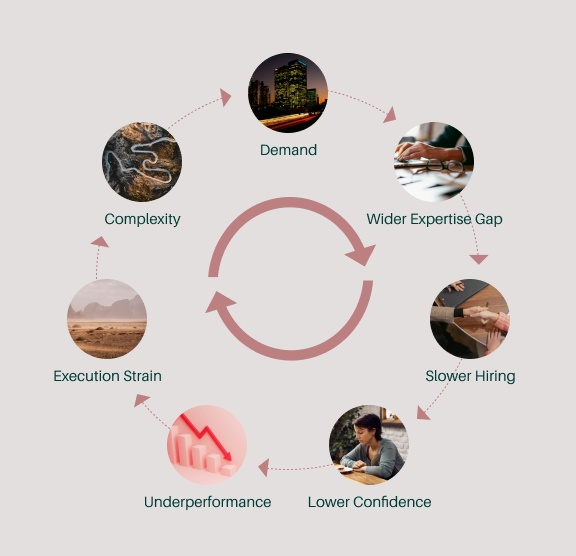
As systems get more complex (renewables, digital control, storage, electrification), traditional execution models struggle more, increasing the expertise gap over time.
Energy companies are scaling into markets shaped by renewables, storage, electrification, digital controls, regulatory change, and rising reliability expectations. Each new layer increases the need for coordination across technical, financial, commercial, and operational functions. A weak execution model may hold during early development. Under the weight of project delivery, investor scrutiny, and customer obligations, it begins to show.
The pattern is familiar. Execution slows; costs rise; milestones slip. Investor confidence becomes harder to maintain, which leaves the company with less flexibility to hire, restructure, or build the capabilities it lacked in the first place. The expertise gap, left unresolved, becomes self-reinforcing.
This is where traditional advisory support often reaches its limit. The founder-level challenge in energy is not simply a shortage of advice. It is a shortage of embedded operating expertise: leadership that understands the capital stack, the project plan, the regulatory landscape, the commercial model, and the daily decisions that connect them.
PhiCap’s Co-Executive Leadership model is designed for that gap. By working alongside founders and executive teams, sector-specialized leaders help translate capital strategy into operating discipline, financial rigor, and execution capacity. The model gives growing energy companies more than an outside perspective. It gives them the leadership infrastructure to scale.
The next decade of energy growth will not be won by capital availability alone. It will be won by the companies that can convert capital into performance.
Executions win the next decade.
Energy companies need more than traditional execution models. Learn more.
Contact us